9.19.2012

When in Rome

Ah, Comrades! It's going to be a truly lovely year. What did I do this weekend? Why, I endured an epically uncomfortable seat for the pleasure of watching Tannhauser "just like the Ancients!"

It was amazing. You could see stars. (Of course, when I'm not in New Hampshire, 70% of the constellations I see are 'Orion's Belt', but never mind that).

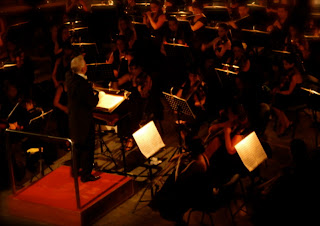
The conductor was delightful. Let's hear it for the Ankara Devlet orchestra.


There was a minstrel singing battle. To the death, guys. To. The. Death. And please note: they all twirled their capes like they were to the manner born. Or perhaps, to the manor born. I've always wondered about that. In this case, both work. It was way regal ... she said with just the faintest touch of irony.


And poor Venus was a demon, with ghoulish minion nymphs capering about all excessively limber.


 Spoiler alert: Chaste Elisabeth dies at the end. Her soul leaked out with all the fervent prayer. Some of those pilgrims may or may not be horribly, blasphemously, jealous.


And on that note, a small burst of vaguely impotent moral indignation from the editor's corner. Get your compassion hats on!

This happens a lot: an author asks me a reasonably thoughtful question about my methods and I respond in kind with a note about the balance required in order to edit both for the author and for the reader, what I've found works best for the kind of writing the author is doing.

Aaand the answer, always, is a variation on a theme: "I had no idea how tricky editing could be!" and then something, always, about how it seems like every author should have an editor each for internal integrity, stylistic coherence, readability, and every conceivable audience.

Perhaps, you generously say, the author thinks this is a compliment. But do you know what this says to your editor? "Editing is not a profession; it's certainly not something that requires any particular skill or talent. I have no idea what you get paid to do, but I certainly had no idea that you earned it."

And all the effort that I put into trying to make sure that my simmering rage isn't dumped in your lap gives me an ulcer.

Please don't do that. Basic etiquette: pass it on. Teach your children. Imagine a new world, a better world.

9.09.2012

Krikes Amighty, What a Summer


I hope everyone had a fabulous summer, completely devoid of melanoma, heat-stroke, and mosquitoes. By those (and other) criteria, mine was a proper blast. Let's hear it for my parents and for all those summer birthdays that make the whole season a veritable parade of cakes!

Ah, but now we're back and that giant calendar I patchworked to the bedroom wall reminds me that December (and its deadlines) is Just Around The Corner. It's cool - I didn't slack off or anything. Finished a promised paper, been doing some reviews, for funsies, and chugging away at the translation of Alanna. And of course, the resettling period is always nice for all those little domestic chores that suddenly present themselves after you've been away. I just now reinforced the hangin' holes in our shower curtain - and yes I did wound myself in the process, thank you. 

Oh no! Alert the authorities! TETANUS!


One last weekend away for a Wagnerian opera at a remarkably well-preserved amphitheater with Husbee's family (and yes, we've got our cushions packed - just like those crazy cushion-toting Ancients) before kicking ourselves back into high gear for the new academic year.


And guys, this is important. Who wants to learn English by hypnosis? 


Happy Fall!


6.21.2012

And Meanwhile, on the Application Front

We're in that funny transition period between active school life and "what teachers do in the summer." And guys, it's not what you may have imagined, watching my middle and high school teachers pack up the classroom at the end of the year. We Are Not On Vacation.

Which is fine and all, but does require a sliiight adjustment.

Oh well.

No way man! 'Slight adjustments' means that I get to make new and improved schedules! To-Do lists! Guys, this is MY FAVORITE.

We've implemented bi-weekly "boot camps" (to ensure regular attention is paid to our personal projects) and among those projects is pinpointing departments to which we'd like to apply, and possible sources of funding. We've given ourselves until June 30th to research departments, professors we're interested in working with, and those elusive individuals and groups interested in sponsoring our endeavors.

This ought to leave plenty of time for department-specific research, getting in touch with relevant faculty, and writing stunningly crafted statements of purpose before the Fall Term whisks us back into the fray.


Go get 'em!


6.12.2012

Webly Roundup

Husbee and I had a lovely week with Ms. Finn Senseney and her Mister, exploring the various architectural and culinary wonders of Istanbul (pictured here: the aptly named "wet burger" and the external east-facing wall of the crown prince's apartments in the Topkapı harem). While we recover from their visit, you all can glory in some of the webly things that have been making me joyous.

Want to make or break a habit? Like charts? Have I got a present for you!

A classically trained opera singer and her orchestra: Srsly Cannot Go Wrong. They're My Brightest Diamond, and Husbee hasn't yet complained that they're playing 24/7. If you're going to be in Amsterdam, they're performing on the 17th.

Are you a writer in need of a organization system for all your sundry submissions? Try Duotrope: a free submission-managing service complete with easily searchable listings for fiction, non-fiction, and poetry. And just when you thought there wasn't enough type-A in your life!

If the summer's superhero blockbusters have re-lit a fire they just can't quench, check out my suggested reading list, in which complex principles of math and physics are explored through the always engaging Marvel Universe.

My friend Wendy's excellent article "The Islam in Islamic Art History" can be found here, along with what looks like a great selection of other art historiography research. Mayhaps in that group y'all will come across another academic writer who has learned how to get a point across!

In honor of my new obsession with Amazon's Mechanical Turk program (I'm hoping I can make enough to cover application fees!), here is an article on the program's name-sake: the chess-playing automaton!

Have a great rest of your week.
-E

6.03.2012

Birthdays and Beacons

First of all, a great big Happy 60th Birthday to my father, kicking off Birthday Season in grand tradition. Diamond Jubilee got nuthin' on us!

And to celebrate both my father's retirement and the long-awaited end of the Spring semester, I want to share our summer anthem, courtesy of They Might Be Giants. Fair warning: it does actually get stuck in your head a bit.


Now let's see: I promised some beacons of excellence in academic writing, didn't I? Let it never be said that I don't deliver the goods! But no suggestions from you all? My faithful and most delightful readers? Have you really not once read something well-written and enjoyable for a class or research? Sounds like someone ought to go have a little chat with your professors, for this simply will not stand.

Well, I suppose that means you'll be all the more pleased with me for rounding these up for you.

In no particular order:
  • Douglas Robinson, on translation practice and theory. His work can mostly be found on his academia.edu profile. Bless him and whoever taught him how to share.
  • Donna Haraway, on feminist theory and the history of science. You can download a PDF of her article "Situated Knowledges" here.
  • Borges, though perhaps better known for his fiction, nevertheless is an excellent writer of non-fiction. His 'Selected Non-Fiction' used to be available on library.nu (sadly shut down), but perhaps the more industrious of you have found an alternative. Any news on the book-sharing front would be much appreciated.
  • Anne Fadiman, while not strictly an "academic writer," is the reigning queen of creative non-fiction. Her personal essays are clear, engaging, beautifully written, and incredibly informative. Makes for a great palate cleanser. You can listen to her reading an excerpt from one of her essays here.
I hope that will hold you for now, and if anyone has anyone to add to our list of Those Deserving of Praise and Admiration, please do share the wealth!

Happy Sunday, y'all.
Tune in next week for some tips and suggestions as we start the search for our perfect graduate program. Who said summer was for beaches? I'll be courting myopia, not melanoma...

If you just can't wait, here is an article by yours truly on how to get and stay in the academic loop (and thereby never miss yet another freaking deadline).

Toodle-oo!

5.31.2012

A Handy Mission Statement

 If you have not read George Orwell's essay "Politics and the English Language" I urge you to rectify the situation immediately (links provided below, no frets). Although of course I first absolve you of the oversight. The title is a bit misleading, allowing people who write in academia (and therefore, theoretically, not in politics) to think its wisdom and chastisement don't apply to them.

For our purposes, the essay might be more aptly titled "How to Communicate Complicated Thoughts Clearly and Effectively, and the Importance Of Doing So." 
The problems Orwell spots in political writing can and does apply to all academic fields: 
The first is staleness of imagery; the other is lack of precision. The writer either has a meaning and cannot express it, or he inadvertently says something else, or he is almost indifferent as to whether his words mean anything or not. This mixture of vagueness and sheer incompetence is the most marked characteristic of modern English prose...
That machete-sword thing he's unsheathing over there is for brutally killing, and thereby ending the writing careers, of anyone who persists in either laziness or incompetence. Death to he who uses language as an instrument for concealing or preventing thought. Grrr. Arg.

The Mad Hatter is an excellent specimen of literary delight, but heaven help you if you've been channeling him in your academic writing.

You can find the full text of Orwell's essay here, as beautifully formatted as it is on paper. I have no words for Mt. Holyoke's comparatively unreadable version, but you're welcome to click and gawp if you need a quick fix. By this weekend I'll have corralled a respectable collection of rigorous and aesthetically pleasing academic writing which I believe is working to reverse the process of general decline. If you've read anything that you think fits that general description, please leave a message after the beep.

5.28.2012

The Sincerest Form of Flattery


Friends, I would like to share a peeve with you. A peeve of the petly variety, and one I believe many of you share.

Bad Writing.

Bad writing can be found everywhere, and is mostly avoidable. Come across a badly written blog? Don't read it. Or hate-read it, if your grammar sirens aren't paralyzing. A badly written novel stays on the shelf. Badly written poetry goes out of print.

Badly written academic work, tragically, is often unavoidable. It's on the syllabus, or it's related to your research. Or maybe it was written by someone in a department to which you'd like to apply, and like any diligent potential applicant you want to acquaint yourself with the work of potential advisors and colleagues.

Torture, as we of the Gitmo generation know, is illegal. And mean. And really just not all that effective. Which I suppose makes the vast majority of academic writing in violation of the Geneva Convention. Come on guys!

Academics, by all accounts, have to read a lot. And reading a lot, it's widely believed, is crucial to writing well. But the vast majority of the academic papers and books I've read during the course of my academic career have been convoluted wormholes of headache-inducing ineffective communication. And I don't just mean the professors suffering from Publish or Perish fever who don't edit their work and frankly don't give two figs about the suffering of their potential future readers. I mean Big Names. Like Spivak and Butler. Even poor Derrida is completely misread, and while I'll allow that some of that is laziness on the part of researchers who would rather read a paper about his writing than his writing itself - but only some of that recalcitrance is laziness. Some of it can probably be attributed to the sheer overwhelming volume of work, and the incredibly low bar set by so very much of it.

Where did we go wrong?

Well, I won't go into that. But I will go ahead and give you the silver lining (which I feel I should tell you is pretty glorious): having identified a problem, we have ourselves a cause! Even the most crowded of fields have wide swathes of unreadable research, and if you have the stamina and super-human decoding power necessary to synthesize and reformulate, you can raise that bar.

Stay tuned. The next installment will highlight the rare gem that is quality academic writing. Please, if you've stumbled across any particularly excellent writers in academe, do share. As many ways as it can all go wrong, there must be as many ways for it to be done right.